


 Courses
About the Course
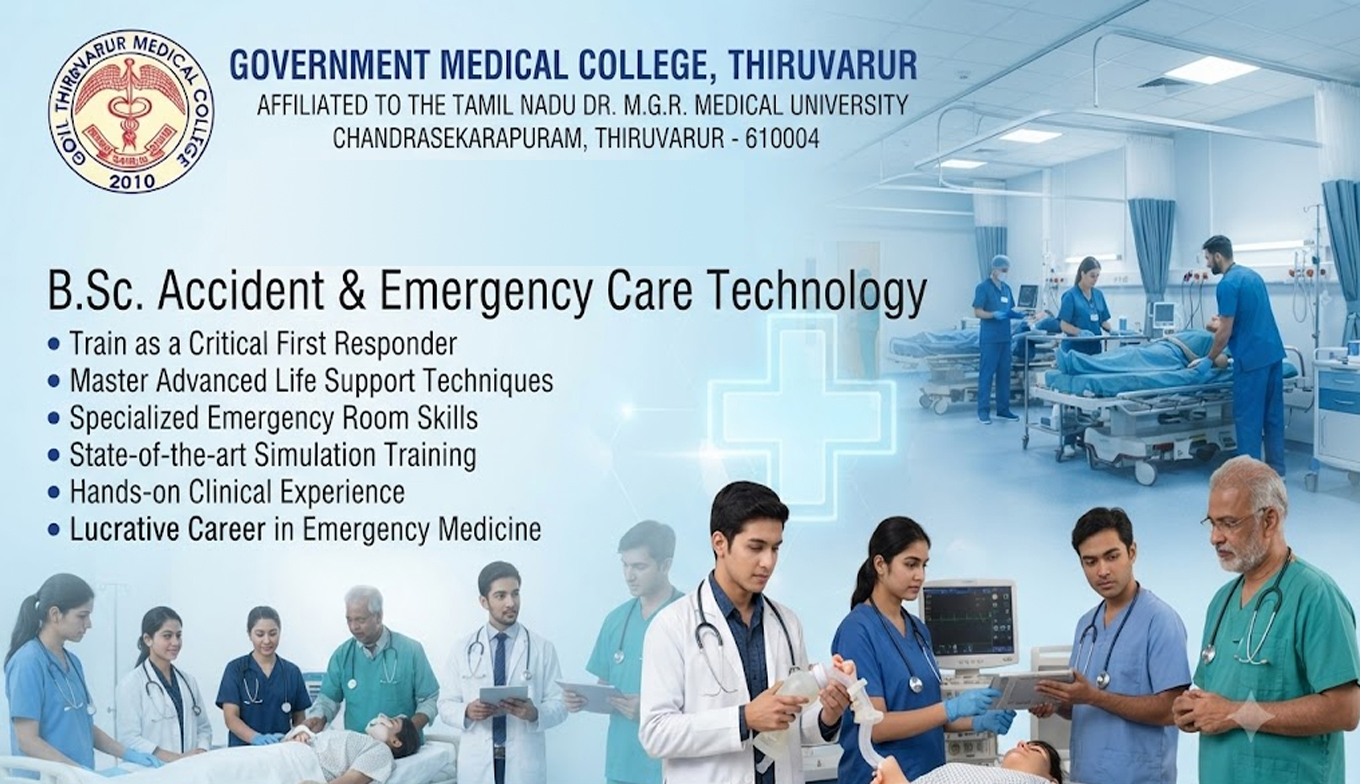
Government Thiruvarur Medical College offers the B.Sc Accident & Emergency Care Technology programme designed to develop highly skilled emergency healthcare professionals capable of providing immediate medical assistance, trauma care support, critical patient management, and life-saving healthcare services during emergencies and accident situations. The programme focuses on emergency medical response, trauma stabilization, critical care support, disaster management, and emergency healthcare coordination.
B.Sc Accident & Emergency Care Technology combines theoretical learning, simulation-based education, hospital-based emergency training, critical care exposure, and practical clinical experience to prepare students for fast-paced emergency healthcare environments. The programme emphasizes rapid clinical assessment, emergency response techniques, patient stabilization procedures, and multidisciplinary healthcare teamwork.
Students receive extensive practical exposure through
- Emergency and trauma care units
- Ambulance and pre-hospital care services
- Intensive care unit training
- Critical patient monitoring
- Emergency procedure assistance
- Disaster and mass casualty management
- Advanced life support exposure
- Hospital emergency department postings
The programme develops expertise in
- Emergency medical response
- Trauma care and stabilization
- Critical care support
- Cardiac emergency management
- Airway and ventilator support
- Disaster management and triage
- Emergency diagnostic procedures
- Patient transport and monitoring
About the Curriculum
The curriculum for B.Sc Accident & Emergency Care Technology is structured according to university regulations and modern emergency healthcare requirements. The programme follows a practical-oriented academic framework focused on emergency medical competency, trauma care management, critical care support, and patient safety.
The curriculum includes:
- Human Anatomy and Physiology
- Emergency Medicine Principles
- Trauma Care Management
- Critical Care Technology
- Cardiac Emergency Care
- Emergency Pharmacology
- Airway and Ventilator Management
- Disaster Management and Triage
- Emergency Diagnostic Procedures
- Intensive Care Support
- Patient Monitoring Systems
- Medical Ethics and Professionalism
- Healthcare Communication Skills
The academic structure emphasizes:
- Practical emergency care training
- Simulation-based learning
- Hospital emergency postings
- Critical care exposure
- Emergency procedure demonstrations
- Trauma management workshops
- Research and project work
- Continuous practical assessments
Eligibility Criteria
- Successful completion of Higher Secondary Education (10+2) or equivalent
- Physics, Chemistry, Biology/Botany & Zoology as core subjects
- Minimum qualifying marks as prescribed by the institution and university
- Compliance with admission regulations and eligibility norms
Admission Process
- Submission of application forms
- Academic merit evaluation
- Certificate verification
- Eligibility confirmation
- Fee payment and admission confirmation
Course Duration
The B.Sc Accident & Emergency Care Technology programme has a duration of 3 to 4 years including academic study, practical training, hospital emergency postings, and internship exposure as prescribed by the affiliating university.
- Classroom academic learning
- Practical laboratory sessions
- Emergency department exposure
- Trauma and critical care training
- Simulation-based skill development
- Internship and clinical postings
Internship Structure
- Emergency department rotations
- Trauma care management
- Ambulance and pre-hospital care exposure
- Intensive care unit postings
- Emergency procedure assistance
- Cardiac emergency support
- Disaster management participation
- Patient monitoring and stabilization
Career Opportunities
- Emergency Care Technologist
- Trauma Care Assistant
- Critical Care Technician
- Emergency Medical Technician (EMT)
- Intensive Care Unit Technician
- Ambulance and Pre-Hospital Care Specialist
- Cardiac Emergency Support Technologist
- Disaster Management Healthcare Assistant
- Emergency Department Coordinator
- Healthcare Safety and Emergency Response Executive